Unpacking Colonial Origins and Exploring Alternatives
Introduction
The language we use to describe regions, peoples, and geographies is never truly neutral. It carries history, power, and perspective. The term ‘Middle East’ is an example, as it locates an entire region not by its own geography, but by its distance from Europe. Decades after the collapse of formal colonial empires, this terminology continues to be used; embedded in news headlines, academic institutions, and policy circles worldwide. By continuing to use a term, we risk perpetuating a worldview in which ‘The West’ remains the default reference point. In this article, we look at the colonial origins of the term Middle East and explore the alternative terminologies applied by people from the region. We also argue how using this term further embeds colonial mindsets.
Colonial origins
In 1900 the British Colonial footprint stretched across the globe and was expanding (it would later reach its territorial peak in 1921). Europeans had already divided the world into two unequal halves, the Occident or ‘the West’, and the Orient or ‘the East’, with Britain in the centre. Realising that the Orient was enormous, in 1902 an American naval strategist coined the term ‘Middle East’ to describe the region between Arabia (the ‘Near East’) and India as well as what lay beyond it (the ‘Far East’).
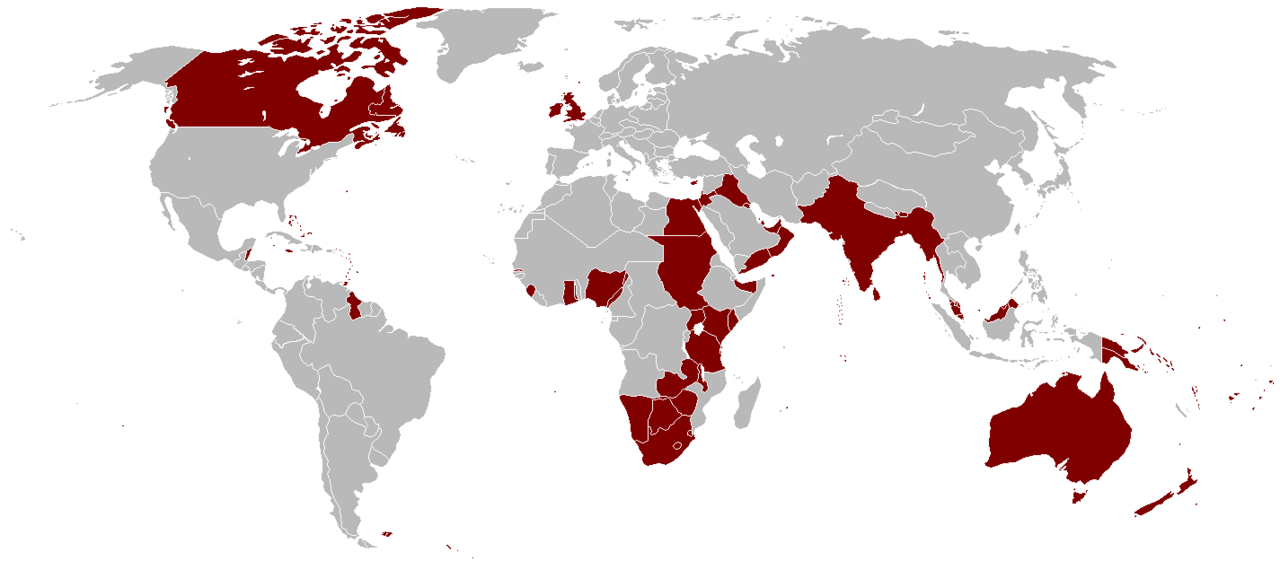
Map of the British Colonial Empire in 1921 Source: Wikipedia
But unlike other world regions, the imagined division of the East into near, middle, and far was not a neutral description of cardinal direction; it represented areas of colonial influence in relation to the assumed centre of the world; Britain. Other colonial powers followed suit, directly translating the Middle East into Moyen-Orient (French), Medio Oriente (Spanish and Italian), Médio Oriente (Portuguese), Naher Osten (German), and Midden-Oosten (Dutch), among others. Today, the term Middle East has been broadly accepted as official terminology encompassing the countries from Egypt to Iran, as shown on the map below, although the specific countries considered to be part of the Middle East (sometimes grouped with North Africa) differ depending on who is defining it.
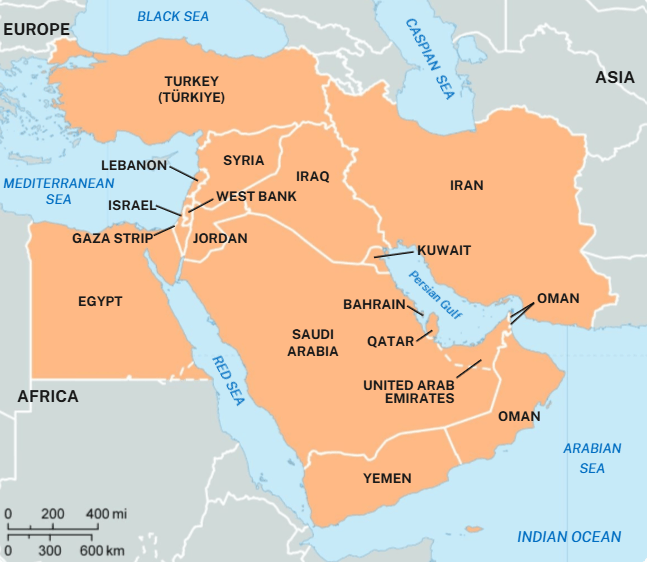
Map of the ‘Middle East’ per the Encyclopaedia Britannica Inc.
Pushing back
Calling this part of the world the ‘Middle East’ is the equivalent of continuing to call the Caribbean region the ‘West Indies’. In parallel, we would never refer to Britain as the ‘Middle West’ or the United States as the ‘Far West’. So why do we still cling to these colonial frameworks?
This is exactly why during an interview, Egyptian Feminist Dr Nawal El Saadawi interrupted the discussion to question why we still use the colonial language of the Middle East. ‘You have to ask yourself, middle to whom?’ And as Lebanese Thought Leader Mounir Ajam has asked, ‘If Far and Near East are not being used anymore, why do we still use ‘Middle East’? Why [does] this term persist?’
Adding ‘North Africa’ to ‘Middle East’ to create the common acronym ‘MENA’ does nothing to alleviate this problem. It still lumps these two regions together, one described based on its own continental geography and the other based on its relationship with Europe, under a single umbrella that fails to acknowledge their distinct identities and historical experiences.
Alternatives – where they come from and what they mean
- ‘Maghreb’, or ‘the place where the sun sets’, is a term used by Arab scholars of the medieval Islamic world to refer to the western portion of the Arab and Islamic world, encompassing what is today Morocco, Algeria, Tunisia, Libya, and Mauritania. The term is not inclusive of all Arabic-speaking countries but focuses solely on those in North Africa.
- ‘West Asia’, or ‘West Asia and North Africa’ (WANA), or ‘Southwest Asia and North Africa’ (SWANA) are used in Arabic, although not as widely as ‘Middle East’. Much like ‘Southeast Asia’ or ‘North Africa,’ these terms are grounded in geography, defining the region in relation to its continental positioning. They also account better for its internal diversity while still capturing the connections and proximities among its constituent parts. The term is relatively new, but slowly gaining traction within the aid and wider sectors.
- ‘The Arab world’ is used to highlight the linguistic, cultural, and historical bonds shared among Arab peoples across 22 member states. However, this terminology excludes non-Arab-speaking nations and, perhaps more significantly, overlooks the many non-Arab communities that form an integral part of the region’s diverse social fabric, including the Kurds, Amazighs, Armenians, Assyrians, and numerous others.
- ‘The Muslim world’ or ‘The Islamic world’ are also sometimes used to reflect a broader group of countries where Islam is a major religion, but inherently excludes the significant non-Muslim communities and encompassing Muslim populations well beyond its boundaries.
Way forward
This article presented the origin of the term Middle East, examined how it came to define the region through a colonial lens, and proposed alternatives that describe the region on its own terms. Maghreb, WANA, and SWANA are alternatives that shift the focus away from a Eurocentric vantage point and toward the region’s own geography. The Arab, Muslim, and Islamic worlds speak more to a shared identity than a specific geographic orientation.
As the words we use to name a place or a people are never neutral, some conventional labels carry a history worth reconsidering. Changing the language we use is a small but meaningful step toward shifting our perspectives on how we see the world.
 Shift Consultancies
